显示标签为“Alumina Magnesia Carbon Brick”的博文。显示所有博文

2017年5月16日星期二

What are the processes for the preparation of magnesium carbon brick

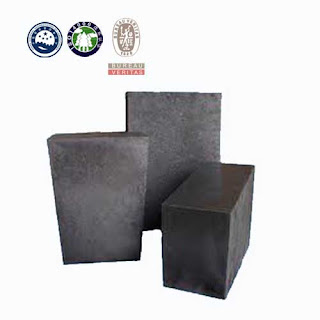
magnesia carbon brick
Changxing Refractory is able to manufacture magnesia carbon brick for every ladle, EAF, and BOF. We will design you a well-balanced lining, providing optimal performance at the lowest possible cost. Our magnesia-carbon brick is made from more than 98% electrically fused magnesite, high purity graphite and metallic antioxidants as needed. Size and specification can be tailored according to furnace type.


Magnesium carbon brick is a high melting point of basic oxide oxide (melting point 2800 ℃) and difficult to be slag invasion of high melting point carbon material as raw material, add a variety of non-oxide additives. With carbonaceous binder combination of non-burning carbon composite refractory.

The traditional magnesia carbon brick produced by the synthetic tar binder in the cold mixing process is hardened during the process of tar damage and the necessary strength is obtained, thus forming isotropic glassy carbon. The carbon does not exhibit thermoplasticity, and the thermoplastic properties are eliminated in a large amount of stress during lining or during operation. The bituminous carbon brick produced by the asphalt binder has a high high temperature plasticity due to the formation of anisotropic graphitized coke during the asphalt carbonization process.

Therefore, the use of asphalt combined with the brick crack resistance is higher than the asphalt bonded brick. However, one of the disadvantages of bitumen-bonded bricks is the need for thermal mixing during the production and the provision of a brick mold preheating device. In this paper, the method of making MgO-C bricks  by cold mixing process is described. The resulting bricks have a lower modulus of elasticity so that they act to eliminate stress during operation. Ordinary coal tar pitch is harmful to environmental protection because of the presence of benzophen. The choice of benzene and low content of the special meet the environmental requirements of the binding agent.

In order to improve its oxidation resistance, can be added in the ingredients such as Si powder, Al powder, SiC powder or ferrosilicon powder additives, resin as a binder, high pressure molding, after 200 ~ 300 ℃ treatment can be used without Calcined. Mainly used for large-scale converter and ultra-high power furnace steel lining and furnace refining furnace lining and so on.

With the increase of carbon content, the bulk density and compressive strength of the magnesia-carbon brick are reduced. When the carbon content is between 6% and 8%, the high temperature flexural strength, thermal shock resistance, slag resistance and oxidation resistance of the magnesium carbon brick are good The carbon content is low and the slag resistance of the magnesia carbon bricks manufacturers is reduced. When the carbon content is 14%, the oxidation resistance of the magnesium carbon brick is the worst.

2017年1月4日星期三

The difference between anti-peeling high-alumina brick and ordinary high-alumina brick

Refractories are widely used in metallurgy, building materials, chemicals, petrochemicals and machinery manufacturing and other industrial areas, play an active role in the national economy. However, the application of refractories in high-temperature furnace evaluation, in addition to improving the service life, lower kiln energy consumption, it should also contain refractories in the production process of their own energy-saving, that is selected in the production of low-temperature firing, the product has the appropriate Of the high-temperature characteristics and low thermal conductivity.

Compared with the traditional high alumina brick, the thermal shock resistance is high, the strength is high, the chemical resistance is low, the coefficient of thermal expansion is low, the thermal conductivity is low, the firing temperature is low, and the material function is greatly improved. Consumption.

From the following aspects to clarify the problem:

First, the lower firing temperature 150 ~ C. Because of high temperature firing and insulation, especially in the greater than 1450 ℃ after the refractory refractory energy consumption can be infinite, according to the present refractory brick high-alumina brick 300,000 t / a count, estimated savings of 50,000 tons of standard coal.

Second, compared with the traditional high-alumina bricks, anti-shedding high-alumina brick thermal conductivity value of the former 2/3, or even lower, compared with magnesium chrome brick, as long as 1/3 ~ 2/3. Anti-shedding high-alumina brick and adjacent alkaline brick, lower carcass surface temperature 75-98 ℃, preliminary accounting can save nearly 2000t / a standard coal. Saving effect, considerable economic benefits.

Third, the traditional high-alumina brick can not enter the large-scale dry kiln, due to the use of life is too low, repair, stop kiln frequently form considerable energy loss and economic losses. More noteworthy is that it can not overcome the inherent weaknesses in the use of harsh locations.

Fourth, the world today with the rapid development of industry, to the formation of the Earth's environmental pollution infinite economic losses, the serious problems of human health has been more and more people's attention. In order to make a long life, we must take into account the material itself can not be a source of pollution. The excellent function of anti-shedding high-alumina bricks can largely replace the magnesia-chrome bricks. Magnesia-chrome brick in the course of processing and waste brick processing will bring serious "chromium pollution", its scientific component is carcinogenic substances. In Europe and the United States has gradually abandoned the production and use of this material, and quickly developed in the development of chromium-free goods, and anti-shedding high alumina brick is an excellent alternative.

The anti-drop high alumina brick is successfully used in the relevant parts of the cement kiln and used in the large-scale float glass kiln regenerator, instead of the traditional magnesia chrome brick, not only prolongs the kiln service life, but also eliminates the chromium pollution. In addition, the anti-shedding high-alumina brick firing temperature than magnesium-chrome brick low about 300 ℃, energy-saving effect is considerable.

Anti-shedding high-alumina brick as a versatile and efficient new energy-efficient refractory material, the American Ceramic Society magazine will be informed of this material as "the development of a potential by China's new high-alumina refractories." Anti-shedding high-alumina brick in the metallurgical and building materials industry has a wide range of applications.

Anti-peeling high-alumina brick and the difference between ordinary high-alumina brick

Refractories are widely used in metallurgy, building materials, chemicals, petrochemicals and machinery manufacturing and other industrial areas, play an active role in the national economy. However, the application of refractory in high-temperature furnace evaluation, in addition to improving the service life, lower kiln energy consumption, it should also contain refractories in the production process of their own energy-saving, that is selected in the production of low-temperature firing, the product has the appropriate Of the high-temperature characteristics and low thermal conductivity.
In this case,
Compared with the traditional high alumina brick, the thermal shock resistance is high, the strength is high, the chemical resistance is low, the coefficient of thermal expansion is low, the thermal conductivity is low, the firing temperature is low, and the material function is greatly improved. Consumption.
In this case,
From the following aspects to clarify the problem.
In this case,
First, the lower firing temperature 150 ~ C. Because of high temperature firing and insulation, especially in greater than.

2016年12月12日星期一

Magnesia Alumina/Alumina Magnesia Carbon Brick---Refractory Brick---Refractory Material---Changxing Refractory

Magnesia Alumina/Alumina Magnesia Carbon Brick---Refractory Brick---Refractory Material---Changxing Refractory
Alumina Magnesia Carbon Bricks are used in Ladle Sidewall and Bottom impact areas.
Magnesia Alumina Carbon Brick, Alumina Magnesia Carbon Brick

Introduction:
Alumina Magnesia Carbon Bricks is made from high quality bauxite, corundum and fused magnesia. It is formulated with very high purity alumina and magnesia.

Advantages:
It has low thermal conductivity, good isolation ability, and appropriate residual expansion

Application:
Alumina Magnesia Carbon Bricks are used in Ladle Sidewall and Bottom impact areas.

Henan Xinmi Changxing Refractory Material Co., Ltd. Located in Henan Province,China.ChangXing's product portfolio covers shaped products such as refractory materials,refractory brick, refractory castable,refractory nozzle, ceramic fiber, slide gate, etc; unshaped products including repair, construction and casting mixes and mortars.exported to more than 20 countries, such as Thailand, Indonesia, Pakistan, Saudi Arabia, South Africa, Turkey, Iran, Iraq and so on.

Content source:
http://www.yilongrefractory.com/AllProductOneServlet?id1=1&id=4
E-mail:sales8@chinaelong.com

Refractory Material, Fire Bricks, Refractory Manufacturer, China Refractory - CX Refractories

Refractory Material, Fire Bricks, Refractory Manufacturer, China Refractory - CX Refractories