显示标签为“refractory bricks used in blast furnace”的博文。显示所有博文

2017年11月28日星期二

Application of Dry Sludge in Refractory for Blast Furnace

blast furnace refractory
Blast furnace refractories are often used stemming, commonly used is a water cannabis mud, but when the steel production is high, this iron mouth stem mud is more susceptible to mechanical scouring and chemical erosion of slag iron, resulting in blast furnace slag Not a net, not only affect the smooth and high yield blast furnace, but also prone to iron in the refractory brick process of iron off, leading to runway accidents caused by heavy run. At the same time as Tietou tide, prone to playing Tietou "rocket" burns and other accidents.
The main production of anhydrous stemming ingredients ratio (%): Brown Iron Jade 15-24, 6-15 silicon carbide, coke 20, lime 12-16, tar 18-20. The gun mud compressive strength of 20Mpa, open the mouth opening in the blast furnace refractory openings easy, and anti-erosion performance is better.
The key component of lime mud is too large, will cause mud shrinkage is too large, resulting in cracks, too small, affect the mud plasticity, in the amount of stemming on the basis of 12%, and gradually found in the burn line changes Is +0.3%, the best performance, high plasticity at the moment, when there is good micro-expansion at high temperature tapping, no cracks, effective from the no swelling, cracks caused by channeling iron, , The risk of burned stave in severe cases.
Key components of low, medium temperature sintering agent added in a large amount, will have an impact on the stability of the iron, sintering agent added to the stemming at low temperature to generate low-melt, so anti-erosion ability of stemming deteriorated, splashing spatter . Found that when the ratio of 2.5%, when dealing with the iron mouth, than the water cannons save 25min time, and does not affect the trenches processing, tapping, the iron flow stability.
The above anhydrous mud in the domestic water heaters No. 1 and No. 2 blast furnace used, compared with the same period of water mud, blast furnace technical indicators are as follows: Tiekou pass rate increased by 2%, the punctuality rate rose 6.6%, iron content Poor pass rate rose 8%, iron mouth tapping wind rate decreased 96%, increase once a day tapping, blast furnace operation safety factor has also been improved. The development and application of this anhydrous stem mud has been extremely successful, contributing to the steady and high yield of refractories for blast furnaces.

Recent article:
How to Choose Refractory Bricks Used for Different Parts of Blast Furnace
E-mail: sales8@chinaelong.com

2017年8月14日星期一

How to Choose Refractory Bricks Used for Different Parts of Blast Furnace


Refractory Brick
Refractory Brick
How to choose refractory brick used for different parts of blast furnace?
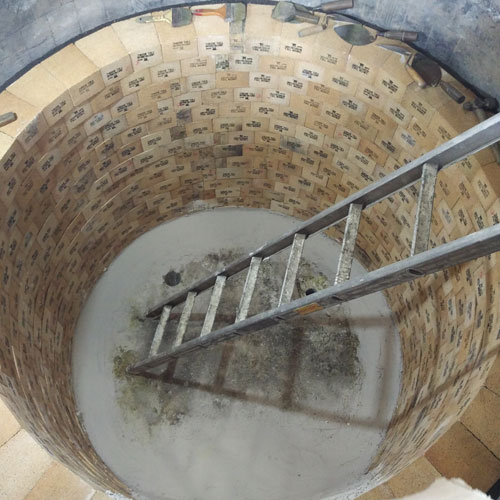
When choosing refractory brick used for different lining parts of blast furnace, we should follow some principles. The refractory lining of every part should fit the parts thermal current intensity, so that the lining can maintain previous vertebral shape and stability under the impact of strong heat flux.

Here are some methods of selecting refractory brick for every part of furnace lining.

(1) Furnace throat. It mainly needs to withstand impact and abrasion of burden, so generally we use steel brick or water cooling steel brick for the furnace throat.

(2) The upper shaft. Plus the burden descent and ascending gas flow of scour and wear. Therefore, we should choose resistance to chemical erosion and abrasion resistance of refractory material, the most appropriate is high relative density brick, high density, high aluminum brick or phosphoric acid impregnated clay brick.

(3) The middle and lower part of furnace and furnace bosh. The main mechanism of damage is thermal shock, high temperature gas scouring, and impact of alkali metals, zinc and carbon deposition, as well as chemical erosion of the initial slag. For those three parts, we should choose refractory materials with properties of thermal shock resistance, slag erosion resistance and erosion prevention. For blast furnace whose volume is smaller than 1000m3, we can use aluminum carbon refractory bricks used in blast furnace.

(4) Furnace bosh. Hot gas erosion and iron slag erosion are the main reasons for furnace bosh damage, this part of the heat flux intensity, refractory material life not long (as long as 1 to 2 months, as short as 2 to 3 weeks), generally used in refractory degree is high, load softening temperature is high and the volume density of refractory material, such as the high aluminum brick, alumina carbon brick.

(5) Hearth tuber. This site is only in blast furnace of oxidation reaction area, high temperature from 1900 to 2400 DEG C, lining by damage caused by high temperature thermal stress. Composite brick masonry hearth tuyere zone is adopted by the modern blast furnace, material for high alumina, corundum Mo mullite; corundum and silicon nitride combined silicon carbide, useful also hot pressed carbon block.

(6) The lower part and bottom of hearth. For those two parts, we use hot pressing small carbon brick, micro porous carbon brick, and hot semi graphite carbon brick with high thermal conductivity, good resistance to penetration, good resistance to chemical erosion, low porosity and micro aperture, as well as brown corundum or gray corundum brick used for ceramic cup.


Article source:
How to Choose Refractory Bricks Used for Different Parts of Blast Furnace

E-mail:sales8@chinaelong.com

Refractory Material, Fire Bricks, Refractory Manufacturer, China Refractory - CX Refractories

Refractory Material, Fire Bricks, Refractory Manufacturer, China Refractory - CX Refractories